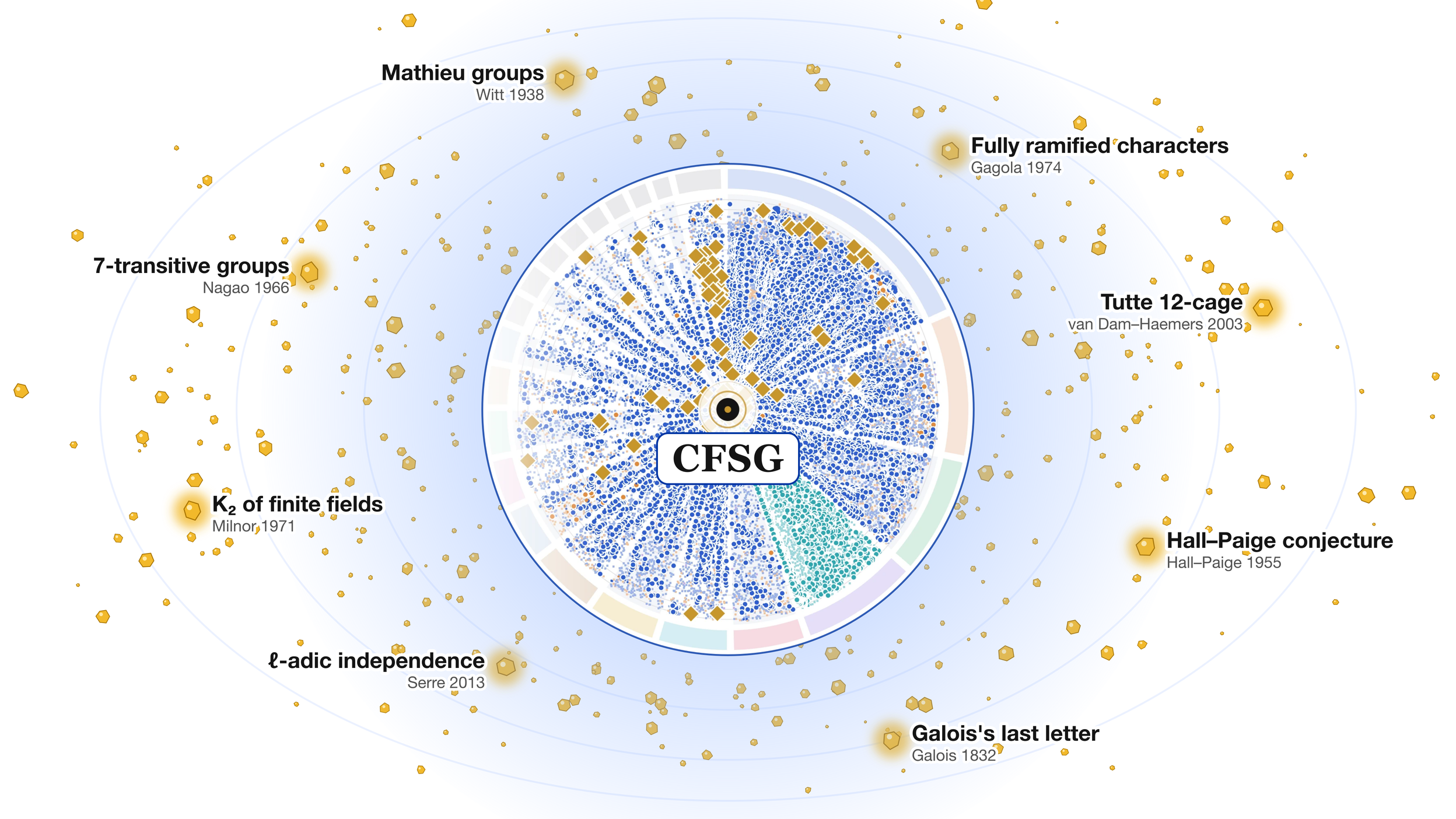
The classification of finite simple groups (CFSG) is one of the largest proofs in mathematics. Axiom Prover formalized it in Lean. The classification theorem is the culmination of an extensive body of mathematics. Proving it in Lean required formalizing a series of milestone theorems, each a major achievement in its own right, along with many supporting results that group theorists rely on every day. The corpus includes Glauberman’s signalizer functor theorem, Walter’s classification of simple groups with abelian Sylow 2-subgroups, and Dickson’s classification of the subgroups of $\mathrm{PSL}_2(q)$, as well as important consequences of the classification, such as Schreier’s Conjecture.
We wanted to test our belief that this collection of milestone theorems and supporting results makes the corpus valuable far beyond the classification itself. We asked Axiom Prover to find 30 published theorems that build on the corpus. Each theorem had to lie outside the CFSG proof and not simply follow from the classification itself. We then asked Axiom Prover to formalize these theorems using the CFSG corpus. The project offers only a small sample. We limited the experiment to 30 results, each formalized in less than a day of agent time. We made no effort to select the most important applications. There are undoubtedly many more, and we hope the community will discover them.
What Axiom Prover formalized
The results span almost two centuries of mathematics, from a claim in Galois’s last letter of 1832 to a 2020 paper on perfect codes in Cayley graphs. To our knowledge, none of them had been formalized before. Highlights include the Hall–Paige conjecture [1], with all 26 sporadic groups covered, and Serre’s remark [2] that simple groups of Lie type in different characteristics $\ell, \ell' \geq 5$ have different orders. The full list, with the Lean code and the informal statement of each result, is at AxiomMath/CFSG-applications. We have also used the corpus to solve several previously unsolved LeanEval problems, which we will report on separately. Figure 1 summarizes all 30 results. We then look more closely at a claim from Galois’s last letter, the Hall–Paige conjecture, and the characterization of the Tutte 12-cage by its spectrum.
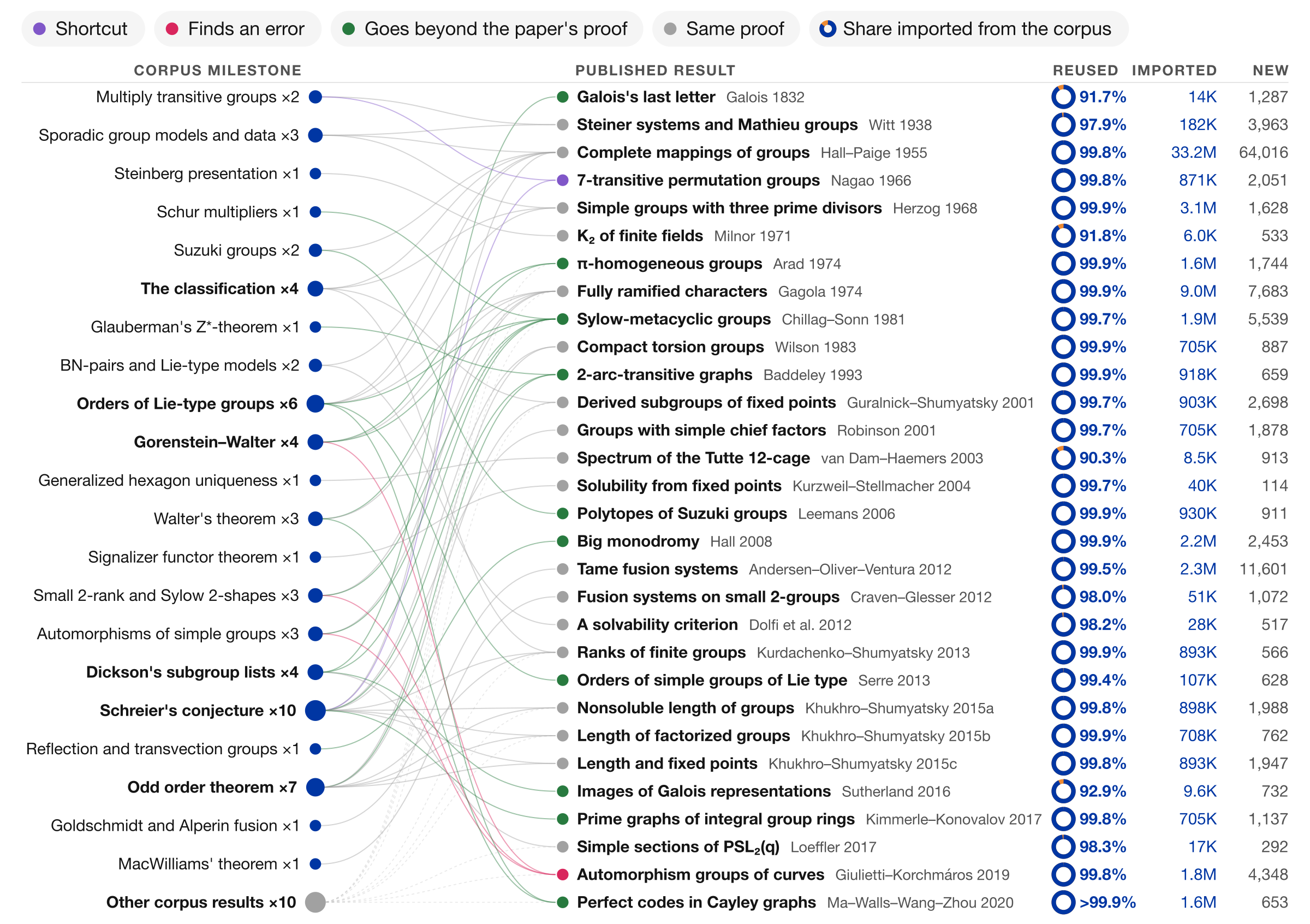
The amount of new formalization required for these results is notably small. A typical result cites corpus theorems whose proofs run to about 880,000 lines of Lean code, and adds about 1,200 lines of its own. More than 99% of the Lean code behind a typical result was therefore already in the corpus. Only the paper’s own argument is new. Without the corpus, most of these results would first have required formalizing large parts of finite group theory. The results draw on more than twenty different parts of the corpus, with several used repeatedly. Schreier’s conjecture alone supports ten results, in areas from integral group rings to graph theory.
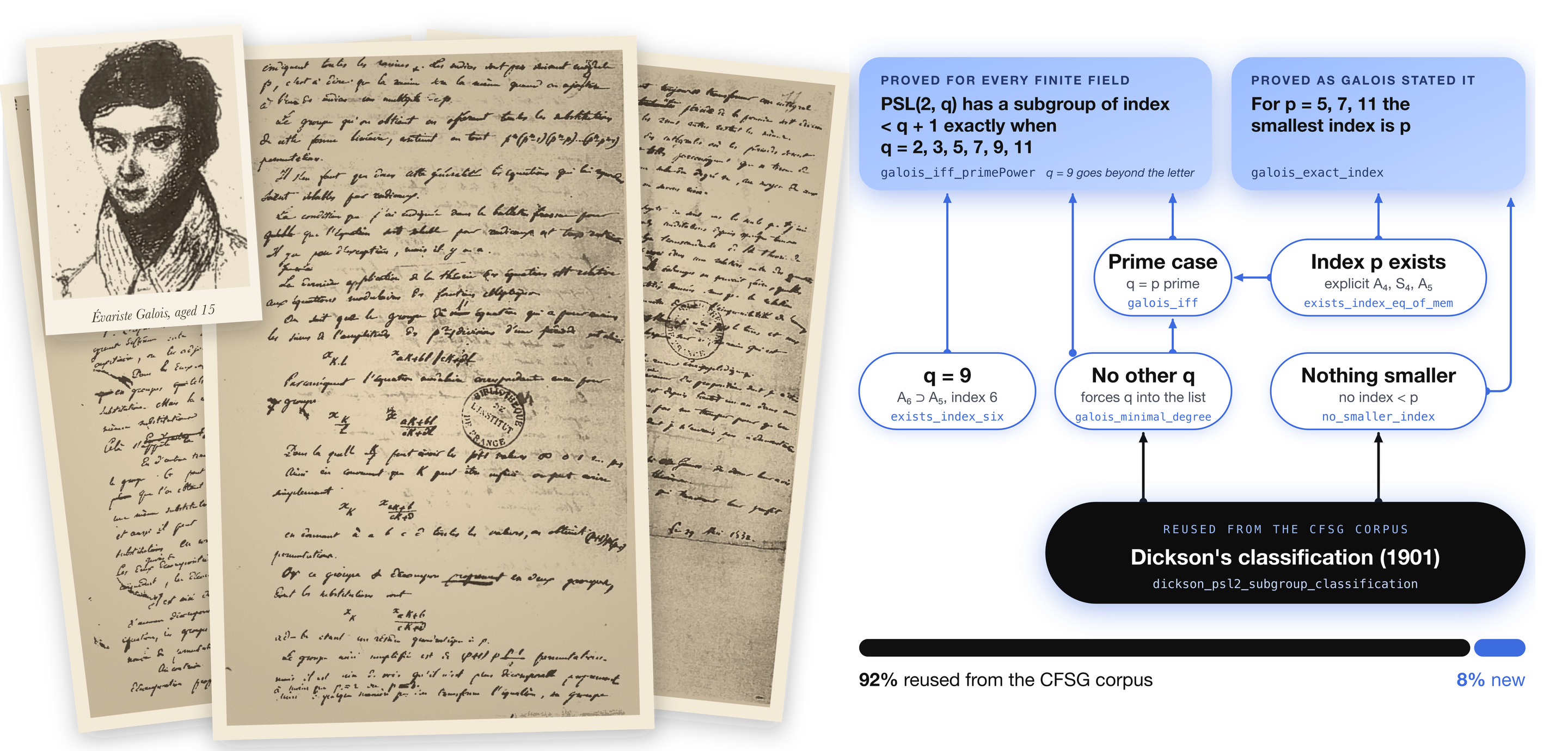
Out of curiosity, we encouraged Axiom Prover to look at some of the oldest results in group theory, and it formalized a claim from the letter Galois wrote on 29 May 1832, the night before his fatal duel. Galois stated, without proof, that a certain family of equations can be simplified only in three exceptional cases, $p = 5, 7$ and $11$. Axiom Prover formalized the known proof of this claim, and of a version that holds for every finite field. About 92% of the proof is reused from Dickson’s 1901 classification, already in the CFSG corpus.
Where the formal proofs differ
In most cases, the corpus supplied the theorem on which a paper relies, allowing Axiom Prover to follow the published proof. In some cases, the formal proof differs from the published argument. For example, Nagao’s proof (1966) [3] ends by identifying several small groups individually. The library’s classification of 5-transitive groups of degree at most 80 already covers these cases, making that final step unnecessary. A formal proof may also require less advanced theory. Baddeley (1993) [4] relies on results of Teague and Praeger that depend on the classification. The Lean proof replaces them with the Feit–Thompson theorem [5] and Glauberman’s Z*-theorem [6].
Formalizing a paper also means proving the claims it leaves unproved. Serre (2013) [2] stated, following Artin, that simple groups of Lie type in different characteristics $\ell, \ell' \geq 5$ are never isomorphic. He also remarked, without proof, that their orders differ. That remark is now a formally proved theorem. Formalization can also make other aspects of a proof more complete. Ma, Walls, Wang and Zhou (2020) [7] list the simple groups in which every subgroup is a perfect code. The Lean proof also checks a step the paper leaves implicit.
The formalization also found a group missing from a published theorem. Giulietti and Korchmáros (2019) [8] list the possible automorphism groups of certain curves, but the list leaves out $\mathrm{SL}(2,3)$, which occurs on the curve $y^2 = x^5 - x$. Their own computer calculation finds this group, but the printed theorem leaves it out.
Hall–Paige and the verification of computational proofs
The Hall–Paige conjecture concerns a deceptively simple question: when can the elements of a finite group be permuted so that multiplying each element by its partner produces every group element exactly once? Such a permutation is called a complete mapping. Hall and Paige (1955) [1] identified the necessary condition: a Sylow 2-subgroup must be either trivial or noncyclic. Proving that this condition is sufficient took more than fifty years, through work of Wilcox (2009) [9], Evans (2009) [10], and Bray, Cai, Cameron, Spiga and Zhang (2020) [11].
The classification enters through Wilcox’s reduction to simple groups. It provides an exhaustive list of the groups that must be considered, but the classification statement alone does not supply the constructions needed to settle those cases. This is where the supporting corpus becomes essential. It supplies concrete models of sporadic groups, their orders, subgroup information, and data describing their actions. These are substantial mathematical inputs that would otherwise have to be formalized before the Hall–Paige argument could proceed.
For several sporadic groups, the proof uses a subgroup whose complete mapping is already known and studies its double cosets. A double coset consists of the elements obtained by multiplying a representative on the left and right by elements of the subgroup. Suitable conditions on these double cosets allow a complete mapping of the subgroup to be extended to the whole group. For the largest groups, including the Monster, the Baby Monster and the Lyons group, the corpus supplies the group models and decomposition data. The new formalization supplies witnesses establishing the required conditions and checks them in Lean.
The scale of these examples makes reuse particularly valuable. For the Lyons group, the construction uses an action on more than eight million points, but the relevant subgroup has only five double cosets. The corpus already provides this decomposition, allowing the new argument to work with a small number of witnesses rather than reconstructing the entire action. For the Baby Monster, the chosen action does not satisfy the double-coset criterion directly. The formalization instead proves a sufficient condition using Hall’s marriage theorem and a matrix of weights between the orbits of a point stabilizer. Explicit matrix calculations verify the data needed to apply that criterion.
The contribution therefore goes beyond importing the classification theorem. The formalization reuses detailed information about the groups and combines it with new arguments and certificates tailored to the complete-mapping problem. Lean’s kernel checks the certificates, bringing the computational steps within the same verification framework as the abstract mathematics. All 26 sporadic cases, including the Monster, are covered in the conditional proof. That proof currently takes the required corpus results as explicit inputs. Connecting all of those inputs to the full corpus remains in progress.
The Tutte 12-cage and an alternative proof
The Tutte 12-cage provides a different illustration of reuse. It is a connected graph with 126 vertices, three edges meeting at every vertex, and no cycle shorter than twelve edges. Van Dam and Haemers (2003, Table 4) [12] record that this graph is determined by its spectrum: any finite simple graph whose adjacency matrix has the same eigenvalues, with the same multiplicities, must be isomorphic to it. This is a striking conclusion because eigenvalues generally do not determine a graph.
The published route uses a general theorem to show that a graph with this spectrum is distance-regular, meaning that certain neighbor counts depend only on the distance between vertices. A uniqueness result then identifies the graph. The formalization takes a more direct route for this particular example, using a geometric uniqueness theorem already available in the CFSG corpus.
The first part of the formal argument extracts structural information from the spectrum. The number of eigenvalues, counted with multiplicity, gives the number of vertices. Traces of powers of the adjacency matrix count closed walks and constrain the possible short cycles. Together with further spectral arguments, these facts establish that any graph with the prescribed spectrum has 126 vertices, is connected and bipartite, has degree three at every vertex, and has no cycle shorter than twelve edges.
These properties strongly constrain the graph’s structure. Expanding outward from an edge and applying the degree and girth conditions gives a lower bound on the number of vertices. Here that bound is exactly 126. This is the graph structure associated with a generalized hexagon of order two. The corpus supplies the Cohen–Tits uniqueness result [13] for that geometry, up to interchanging points and lines. Interchanging the two does not change the underlying incidence graph, so the uniqueness theorem identifies the graph.
The role of the existing formalization is therefore precise. The new proof establishes the passage from spectral data to graph structure, while the corpus supplies the substantial geometric theorem that completes the identification. The formalization also constructs the Tutte 12-cage and proves its characteristic polynomial. The argument thus verifies the claimed spectrum itself. It therefore gives a more direct route for this particular graph without formalizing the general distance-regularity theorem used in the published treatment.
The example also distinguishes the value of the corpus from the classification statement alone. The proof does not need the assertion that every finite simple group belongs to the classified list. It needs a geometric uniqueness theorem available among the supporting results. Formalizing the classification has made that theorem available for a problem in spectral graph theory.
What comes next
We believe this kind of reuse sets a higher standard for future large formalization projects. Beyond proving its main theorem, a project should demonstrate how its library supports further work. It should reduce the cost of formalizing related mathematics and make previously prohibitive problems accessible. The results presented here provide that evidence for the CFSG corpus. Our formalization of the Stacks Project is already being reused in the same way: our formalizations of the Weil conjectures and Faltings’ theorem are built on it.
The Lean code and the informal statements are on GitHub at AxiomMath/CFSG-applications. We will keep adding results there as we find them, but we are more interested in what others do with the library than in growing the list ourselves. We want to learn which theorems the community uses and what further mathematics they support. If you prove a result using the CFSG corpus, please let us know.